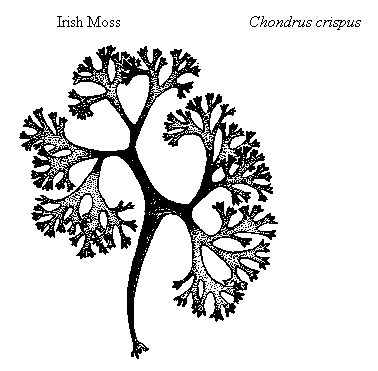
Irish Moss, Chondrus crispus; (Gigartinaceae)
 DESCRIPTION
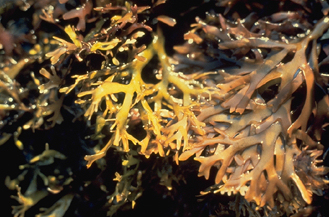
Irish Moss has a root disk, throwing up tufts of many flat, nerveless, slender, cartilaginous fronds, from two to twelve inches in height, sub cylindrical at the base but immediately becoming flat, generally dilating from the base upward until they become three or four lines wide, then dividing repeatedly and dichotomously, each division spreading and becoming narrower than the preceding one, and taking place at shorter and shorter intervals. The summits are bifid, the segments linear, wedge-shaped, varying greatly in length, rounded or acute, straight or curved, often twisted in such a manner as to give the curled appearance denoted in the specific name. The fructification is roundish or roundish-oval, and sub hemispherical. The capsules are imbedded in the disk of the frond, prominent on one side, producing a concavity on the other, containing a mass of minute, roundish, red seeds. The substance is cartilaginous, in some varieties approaching to horny, flexible and tough. The color is a deep purple-brown, often tinged with a purplish-red, paler at the summit, becoming greenish, and at length white in decay (Felk:524-5).
When the Moss is exposed to sunlight, it bleaches creamy white and is then frequently called pearl moss or sea moss.
GENERAL
Here is another moss which is not a moss at all; it is a seaweed. This is another important ingredient in Dr. Christopher's Kelp Combination, which provides a balanced, organic iodine.
MOSS OF THE ROCK
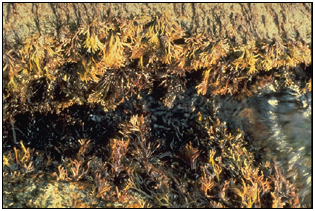
The sea is an inexhaustible storehouse of many things for man. Many people would be hard pressed to make a living apart from the sea; fish supply protein and the algae supply vegetables. It is not too many years since the hucksters could be heard through the streets of Edinburgh peddling the algae. Of the two most popular kinds, Irish Moss is still highly valued today. It is rich in a starchlike substance from which a jelly can be made, but it is much more; it is a healing medicine. This plant is very common in Europe, especially along the wet shores of Ireland, where quantities of it are gathered each year. It also grows on the Atlantic shores of America, large quantities annually collected on the Massachusetts coast. It is found attached by its disk to the rocks along the sea, where it is collected in the springtime, washed, and spread on the sand some distance from the shoreline, and allowed to dry in the sun until it becomes well-bleached and of a translucent, horny texture, when it is ready for market. It was introduced into medicine in 1831 by a certain Todhunter of Dublin (Felk:525).
The name Chondrus means cartilage or gristle, from the Greek. Crispus comes from the Latin, meaning curled or crumpled. Its Irish name, carrageen, means “Moss of the rock”; it is more properly spelled carrageen in Irish. Its extract, carrageenan, is commonly used in food preparation today.
The use of seaweeds for food goes back to the primitive societies of Africa and the Aztecs of Mexico, but today scientists are exploring how the algae can be transformed into palatable, familiar food for hungry nations. The American Indians ate the sea lettuce, Ulva lactua, which is a green seaweed, not only for a condiment or seasoning but as an important source of salt in the diet (Coon:276).
The knowledge of algae is spread throughout the world, going back to earliest medical practices of the Chinese (perhaps 5,000 years ago) when seaweeds were used for the treatment of goiter (iodine treatment), with some species being used for bronchitis, abscesses, intestinal troubles, etc. The Egyptians, Greeks, Romans and other peoples used various seaweeds; one species of Fucus was used to make cosmetics for ladies (Ibid.).
The Japanese today include several species of seaweed in their everyday diet. Some of the most gourmet preparations contain seaweed; we have eaten several of them, and even our children like them very much. Dulse and kelp are recommended by health food teachers as condiment and source of iodine.
Not only commercial concerns gather Irish Moss today; many people along the Massachusetts and other beaches gather and prepare puddings and treatments with the plant. We will provide a recipe below for you to use if you should ever gather it.
 NUTRITIOUS DEMULCENT
Dr. Shook has written more extensively about Irish Moss than any of the herbalists. He said that out of the ocean cometh all life, as the ocean contains every element that manifests life on earth, and because the ocean is the ionizer, and everything soluble in the ocean is ionized, the herbs growing therein being most necessary to the process of healthy metabolism (ShoA: 150). He explained that Irish Moss is heavily laden with sulfates, all of them in soluble form. Its calcium sulfate cleans out any accumulation of heteroplasm or abnormal growths in the interstices of normal tissue. It causes the diseased parts to discharge their contents easily so that they do not lie dormant and slowly decay. This is the main cause of cancer which feeds on decaying organic matter (Ibid: 152). Potassium sulfate, present in Irish Moss, is an oxygen carrier with a powerful affinity for the skin, and tends to keep the skin supplied with material for its healthy functioning. Sodium sulfate is a dropsical remedy because it tends to eliminate water produced by the oxidation of organic matter which lodges in the intercellular fluids. Its phosphates of calcium, potassium, sodium and magnesium feed the bones, brain, liver and flesh respectively. Its potassium chloride dissolves fibrin, and so relieves all colds, while its sodium chloride regulates the necessary amount of water in the system, which we know is the great ionizer and producer of vital chemical changes in the fluids of the body. Finally its magnesium phosphate supplies material for the nourishment of muscle (Ibid.).
Dr. Shook concluded that Irish Moss might be considered good for whatever ails you, from foot and mouth disease to bunions! It is strongly alkaline, presenting the body with sweet organic alkaline salts of four out of seven metals which nature uses to build and vitalize the human body. It provides a trace of iodine, which is just enough to work wonders on the glandular system, often changing the whole chemistry from disease to health. It also contains fluorine, which unites with the metal calcium to form calcium fluoride. This is found in the surface of bone, the enamel of teeth, the walls of blood vessels, and in all connective tissues and elastic fibers. The tensile strength, resiliency, and elasticity of the muscular system, the vascular system, the lymphatic system and the bone and connective tissues all depend on this relatively minute quantity of calcium fluoride, just a fractional part of the herb, but very necessary. Without it the body goes right out of balance and many, many ailments occur (Ibid.).
Dr. Shook admitted that chemical analyses cannot detect the presence of calcium fluoride quantities but he assumed that it must be present in exceedingly minute quantities, not only because it was everywhere present in the sea but because Irish Moss heals in precisely the same way as calcium fluoride.
In former days, Irish Moss was much used in the treatment of chronic bronchial and intestinal fluxes and irritations of the urinary passages. The degree of efficacy in these affections was thought to be due to its demulcent qualities, and possibly also because of its iodine content. It is used in any chronic irritation of the breathing passages, chronic diarrhea, dysentery, scrofula, rickets, enlarged mesenteric glands, irritation of the bladder, kidneys, etc. (Felk:525).
JELLY SEAWEED
Aside from its medicinal uses, which are minimal nowadays, Irish Moss is very much used in cooking and food preparations. If you should gather the Moss, you can prepare it thus: Wash it thoroughly until the sand is out, then spread it out to dry. To one quart of milk add a piece of the moss, about the size of a golf ball, along with three tablespoons of sugar and a pinch of salt. Cook together for a half hour in a double boiler, strain, and allow to cool, adding vanilla for flavor when half solid. Other flavorings can be added as desired (Coon:278). The extracted material can also be used as a kitchen remedy for burns and bruises, or as a hand lotion.
Irish Moss is used for making soups, puddings, etc. It is often made into a jelly by steeping the plant in boiling water until the jellylike substance is soaked out. It is then strained, sugar and flavoring added and cooled into a jelly. If milk is used instead of water, it forms a custard. When chocolate is added, it resembles chocolate pudding. When only a small amount of the dried plant is used, it makes a pleasant and healthful drink. Old-time cookbooks nearly always gave recipes for the making of Irish Moss jellies and custards.
The herb is used as a suspension agent in toothpastes and is used commercially in hand lotions and various creams. It is widely used in the food industry, in the form of carrageenan, as a thickener and smoothing agent. It is used to some extent in the arts as sizing for paper and cotton fabrics in calico printing, for filling mattresses and in America for making beer. Cattle are sometimes fed on it (Felk:525).
HISTORICAL USES
Used for bronchitis, abscesses, intestinal troubles, healthy skin, it is food for the brain, bones, liver and flesh, it is good for colds, glandular system, muscular system, vascular system and lymphatic system, used for urinary tract irritation, intestinal fluxes, burns and bruises.
 CULTIVATION, COLLECTION, PREPARATION
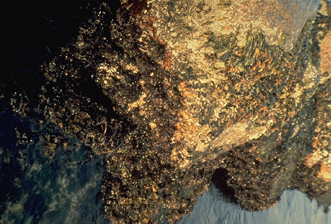
Irish Moss is obtained from the red algae, Chondrus crispus. Commercial supplies are derived from the north and northwest coast of Ireland, from Brittany, and from the Massachusetts coast south of Boston. The algae grow on rocks just below low-water mark, being covered by about a half inch of water at high tide. In Ireland collection takes place during the autumn, in America during the summer. The collectors put out in small boats at about half tide and after detaching a load of algae from the rocks by means of long rakes, return with them at half-flood. Carrageen is bleached by spreading it on the shore and submitting it for some weeks to the action of sun and dew, with about four or five soakings in sea water at suitable intervals. Chemicals such as sulphur dioxide are also said to be used. After drying in sheds the Moss is packed in bales each weighing about 50, 100, 200 or 300 kilograms. After drying, the herb is washed for use and soaked in water. It is then often commercially combined with sugar and other ingredients, such as arrowroot or gum-arabic, and made into a jelly.
RELATED PLANTS
Fucus amylaceus, also called Ceylon Moss or Jaffna Moss. It is also a seaweed, sometimes eaten, which also constitutes the material of the birds' nests used in birds' nest soup by the Chinese.
Agar-agar. This term applies to several seaweeds of the East Indies, and some of these are largely employed by the Chinese for sizing silks and preparing jellies. It is used by vegetarians to make jello-like desserts. It has stronger jelling power than the Irish Moss.
Corsican Moss or Helminthocorton. This is a mixture of seaweeds found in the Mediterranean.
It is a vermifuge.
Dulse or Halvmenia palmatus. This is an edible and delicate tasting seaweed, much prized by health-food enthusiasts.
Gelosine, a Japanese seaweed product, used as a preparation for topical use.
CHEMICAL COMPOSITION
Irish Moss contains oxalate of calcium, compounds of sulphur, iodine, chlorine, bromine, potassium, magnesium, and sodium and a large portion (as high as eighty percent) of pectin matter. Though starch is not present, it develops if the Moss is treated with caustic potash in alcohol. It contains carrageenin, which is the thickening principle.
None of these chemicals are poisonous if taken in the form of the Irish Moss. It should be noted, however, that some individuals with bowel obstructions might take the herb with caution. Some researchers think that there might exist a possible interaction of Irish Moss and any anticoagulant. Individuals on anticoagulant therapy might take special care of using Irish Moss (Spoerke:96).
DR. CHRISTOPHER'S COMBINATIONS CONTAINING IRISH MOSS
The Kelp Combination, which supplies organic iodine, contains Irish Moss.